
Flying Solo on Valentine's Day: A Survival Guide for the One-Person Shop
If you've been following along with this series, the last two blogs were all about organizing your team for Valentine's Day. But what if you don't have a team? What if it's just you? A solo florist needs a different strategy for Valentine’s Day than shops with teams. Working solo means you're designer, delivery driver, customer service, and problem-solver all at once.
The key to surviving (and thriving) as a one-person operation? Working backwards from your actual capacity instead of forward from how many orders you wish you could take. When you start with what's realistic, you can plan every other piece around it.
Here's how to make it work.
Check out part 1: Get Your Studio Ready
Check out part 2: Design Smart, Not Hard
Check out part 3a: You Can’t Do It All
Check out part 3b: You Can’t Do It All
The Keys to Solo Success
Time blocking, capacity management, smart routing, and knowing when to say no. Master these four things and you'll survive Valentine's Day without losing your mind.
Time Block Your Days (Seriously)

Task switching is one of the biggest time-sucks for productivity. And switching from a creative task (designing) to a logical task (anything admin) makes this even more difficult. Layer on the extra difficulty that comes with being tired (and you will be by the end of the week) and without a schedule, you’re asking for a hectic, overwhelming and stressful holiday.
This is true for the florist with a team, but it’s even more critical for the solo florist. You cannot just wing your schedule when you're solo! You need a plan for every single day leading up to and including Valentine's Day.
When determining your schedule, don’t overthink it and don’t plan to the second. Block out time for design, for sales, for routing, and for delivery.
Here's an example:
Wednesday, February 11th:
Morning: design Thursday orders. Start designing Friday orders. Take any new orders that come in.
Lunch break.
Afternoon: prep cards, and organize incoming orders.
Delivery Wednesday orders.
Dinner.
Plan Thursday’s route.
Thursday, February 12th:
Morning: design remaining Friday orders. Start designing Saturday orders.
Pad the design time because you’ll be answering the phone and taking orders during this time.
Lunch break
Afternoon: Prep cards & organize orders taken in the morning.
Deliver
Dinner
Evening: plan Friday’s route.
Friday, February 13th:
Morning: finish designing Saturday orders. Don’t forget to pad the time!
Lunch break
Afternoon: Prep cards & organize orders taken in the morning.
Deliver
Dinner
Evening: plan Saturday’s route
Saturday, February 14th:
Morning: design anything left. If you’re all caught up, start deliveries
Lunch break
Afternoon: deliver
Dinner
Evening: deliver anything remaining (hopefully nothing!)
Notice the pattern? Design, deliver, route for the next day. Design, deliver, route. You're always one day ahead on design and routing.
Are you more creative in the evening? Switch this up and deliver first, then design
Your Checklist:
Map out each day from Feb 11-14
design time
delivery time
routing time
Schedule actual lunch and dinner breaks
Build in buffer time for answering the taking orders
Make orders 1-2 days before delivery (2 days if you have a cooler)
Set a Delivery Window (And Stick to It)
This protects your morning design time and prevents the constant stopping and starting that kills productivity. Give customers a delivery window like 2pm to 5pm or 12pm to 6pm.
When someone asks for a specific time, explain your delivery window. Most people understand. And if you have a customer who doesn’t understand, check out the section below on referral friends.
Your Checklist:
Choose your delivery window
Add it to your website and order forms
Train yourself to quote it consistently
Organize Orders in Sections
This is where the system you set up on the in part 1 comes in. Taking the order but saving the card prep, etc for later, minimizes the disruption to your design time.
Click HERE to see review (scroll down to ‘Organizing Your Orders’)
Your Checklist:
Review the checklist in the Organizing Your Orders section
Know Your Capacity (And Respect It)
This is where solo florists get in trouble. They take too many orders and the whole system collapses. That can be too many orders to design OR too many orders to deliver.
Let’s look at your design capacity
~ If your most popular design takes 20 minutes to design, you can make 3 per hour.
~ If your most expensive design takes 45 minutes to design, you can make 1.3 per hour.
With 4 hours of design time planned, your design capacity is 8 to 10 arrangements.
~ In that 4 hours, you can design 12 of the most popular design or 5 of the most expensive design.
~ If you take 9 popular orders (3 hours), you can only take 1 expensive design (45 minutes).
~ If you take 3 expensive designs (2.25 hours), you can only take 5 popular designs (1.67 hours)
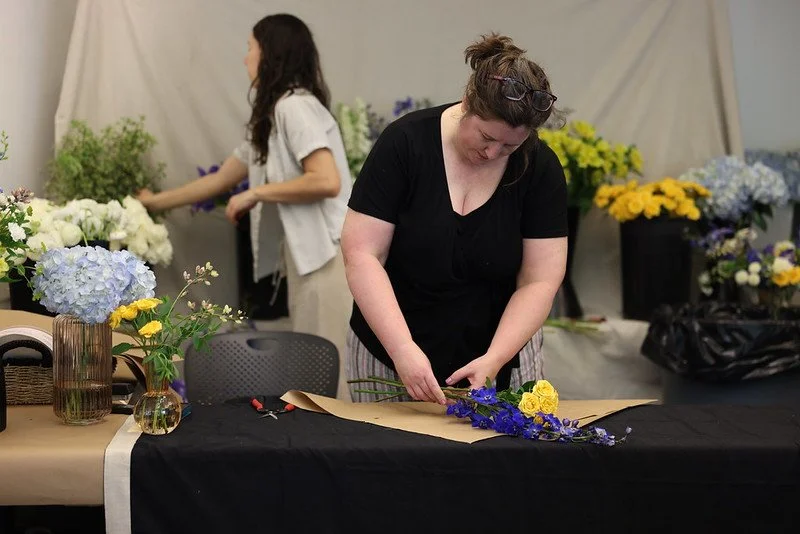
Not sure how long a design takes to make? Do a trial run.
On the delivery side:
If you have 4 hours to deliver each day and each delivery takes 30 minutes round trip, you can handle 8 orders that day. Period.
Math doesn't care how badly you want to take that 9th order.
Not sure how long deliveries will take? Us AI or Google Maps and create a route. Add 5 minutes for each stop. Don’t forget to work backwards from the end of the workday!
Pay attention to both your design capacity and your delivery capacity as you take orders. When you reach a capacity marker, STOP taking orders for that day.
Your Checklist:
Calculate realistic delivery time per order
Count available delivery hours per day
Do the math on maximum daily orders
Stop taking orders when you hit capacity
Limit Your Delivery Area (Yes, Really)
I take orders for a town 30 to 45 minutes away during regular times. On Valentine's Day, I limit delivery to 20 minutes away.
Why? Because 30 minutes away takes an hour round trip. In that same hour, I can deliver two orders that are each 15 minutes away, meaning I can take more orders overall and turn away fewer customers.
I make exceptions for my best customers and really high-ticket orders. But the default is a smaller delivery zone during holidays.
Your Checklist:
Define your regular delivery area
Communicate limits clearly when taking orders

Set Up Referrals with Other Florists
When someone wants delivery outside your area, have a florist you can refer them to. You can either take the order and let the customer know another florist (closer to the recipient) will be designing it or you can give the customer the contact info for the other florist.
This is especially important for low dollar orders that aren't worth the drive time. Instead of losing the customer completely, you're helping them get what they need. You've built goodwill instead of just saying no.
Remember, as a solo florist, you have to be aware of your limits.
Your Checklist:
Find florists in nearby areas that you trust
Exchange contact info and websites to establish informal referral relationship
Keep their info handy by the phone
Refer graciously, not reluctantly
Plan Your Routes the Night Before
Don't wait until morning to figure out where you're going. Route everything the night before.
Use AI and/or Google Maps if you don't have a routing system. Enter all the addresses in AI and ask for a route optimized for time, limited to your delivery window (i.e. 2 hours, 4 hours, etc).
Check it with Google Maps - AI isn’t always right! With Google Maps, you can enter up to 8 addresses and drag them around until you've got the most efficient order.
Group deliveries by area so you're not zigzagging all over town but pay attention to any commitments you’ve made and work-place closing times.
Print or screenshot the route so you're not figuring it out while driving.
Your Checklist:
Route deliveries each evening.
Use AI, Google Maps or a routing program to create a time efficient route
Group by geographic area
Print or save routes
Load car in route order
Double-check. Match addresses and orders before leaving. Don’t forget the add-ons!
The Reality of Going Solo
You will take fewer orders than if you had help. That's okay.
You will be tired. Plan for that. Schedule down-time for February 15th.
You will have moments of chaos. That's normal. Take a breath and go back to your system.
The advantage of working solo is that you control everything. No training, no managing, no coordinating. Just you and your plan.
If the plan is solid, you'll get through it. And you'll probably be amazed at what you accomplished.

Final Thoughts on This Series
Whether you're prepping your studio, building systems, hiring help, or going solo, Valentine's Day success comes down to one thing: having a plan.
You're creative. You're talented. You can make beautiful work under pressure.
But creativity without systems is chaos. And chaos is exhausting.
This blog series has given you the systems. Now it's your turn to implement them.
You've got this. I'm rooting for you.